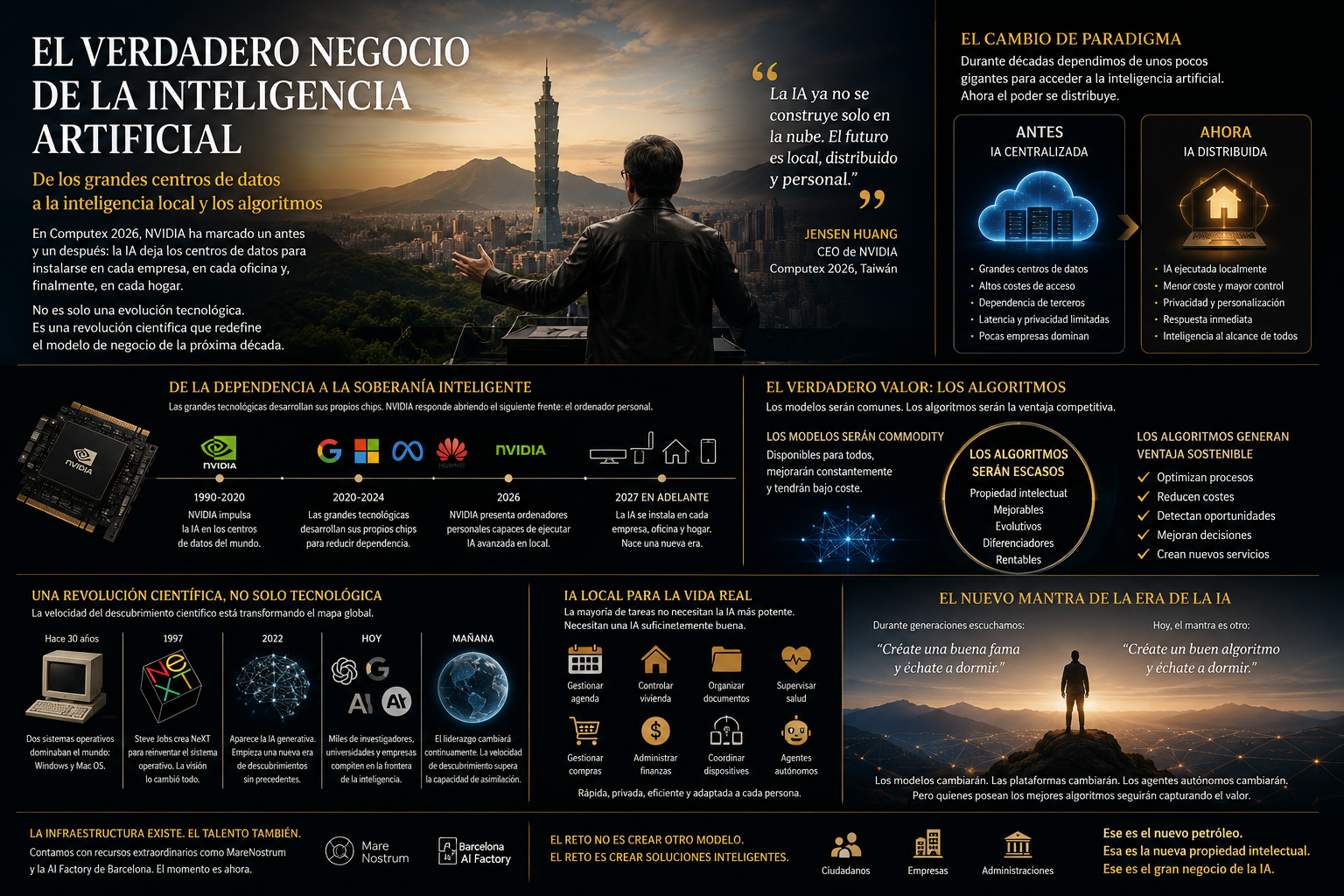
There are times when a news story ceases to be just a news story and becomes an unmistakable sign of where the market is headed. I believe that is exactly what happened this week at Computex 2026, held in Taiwan, which is considered the world’s largest hardware and computing event. On stage was neither a startup seeking attention nor an analyst making a bold prediction. Instead, there were Jensen Huang, founder and CEO of NVIDIA, Satya Nadella, CEO of Microsoft, the world’s leading computer manufacturers, and many of the companies that will shape the future of technology over the next decade.
When players of this caliber come together around a shared vision, it’s worth paying attention.
The news seemed straightforward. NVIDIA unveiled a new generation of computers capable of running advanced artificial intelligence models directly on-premises, without relying on the cloud and without the need for ongoing subscriptions. These machines boast capabilities that, just two years ago, were reserved for large data centers and companies like OpenAI, Google, or Anthropic. However, for me, the important news wasn’t the hardware. The important news was the message behind it.
And the message is very clear: artificial intelligence is moving away from large data centers and beginning to find its way into every company, every office, and, ultimately, every home.
Personally, this news didn’t surprise me. For several years now, I’ve been arguing that the future doesn’t lie in relying permanently on cloud-based artificial intelligence. The future lies in having intelligent systems running locally, connected to our data, our processes, and our actual needs. The interesting thing is that we’re no longer talking about a hypothesis. Now it’s NVIDIA that’s saying it.
And when NVIDIA makes a move of this magnitude, it’s worth asking why.
The answer is simple. Tech giants have been trying for years to break free from their dependence on NVIDIA. Google is developing its own processors. Microsoft is working on alternative architectures. Meta is investing billions in its own hardware. China is moving full steam ahead with domestic solutions and manufacturers like Huawei. Everyone knows that artificial intelligence will be the most important strategic infrastructure of the coming decades, and no one wants to be completely dependent on a single supplier.
NVIDIA is well aware of this situation. It knows it can’t rely forever on selling processors to a handful of multinational corporations. It knows that sooner or later those customers will develop their own solutions. That’s why it has decided to open a second front. If the future no longer lies solely in selling processors for data centers, then it must conquer the personal computer. We must make local artificial intelligence the new standard. We must be present on every desk, in every small business, and in every home.
It’s a brilliant move. For decades, Microsoft made Windows the standard on which virtually all the world’s software was built. NVIDIA aims to do something similar with CUDA and artificial intelligence. It’s not just selling hardware. It’s building the infrastructure for the next technological revolution.
However, I believe that even this explanation falls short. There is another, much deeper aspect that is going unnoticed. I always reiterate an idea that I consider fundamental: this is not merely a technological revolution. It is a scientific revolution.
For more than thirty years, we lived in a relatively stable world. There were two major operating systems: Windows and Mac OS. Innovations were significant, but they emerged at a reasonably predictable pace. Creating an operating system was an extraordinarily complex task. Just recall the story of Steve Jobs when he was ousted from Apple. He founded NeXT, developed a new architecture and a new operating system, and nearly went bankrupt because building that technology required years of work and enormous investments. However, when he returned to Apple, he did so precisely because of that technology. That vision ended up transforming the company forever.
Today we are experiencing something completely different. It has been just three and a half years since the emergence of generative artificial intelligence, and every week we witness a new paradigm shift. If someone asks me what the best AI model is, I honestly don’t know how to answer. If you ask me in the morning, I’ll probably tell you one thing. If you ask me at noon, I might tell you something else. And if you ask me at night, the answer may have changed again.
One week, OpenAI is leading the pack. The next, Anthropic takes the lead. Google delivers an unexpected breakthrough. And then, out of nowhere, a Chinese company comes along and completely changes the game. That’s not traditional technological evolution. That’s a scientific revolution unfolding in real time.
For the first time in decades, we are seeing thousands of researchers, universities, research centers, and technology companies competing simultaneously at the same scientific frontier. And when competition takes place in the scientific arena, progress ceases to be linear and becomes exponential.
We see this all the time. Just a few months ago, it seemed impossible to run certain models outside of large data centers. Today, NVIDIA is introducing personal computers capable of doing just that.
Just a few months ago, it seemed impossible to generate certain types of videos using artificial intelligence. Today, some of the most advanced solutions come from Chinese companies that are competing directly with Silicon Valley.
While many people still think in terms of companies or countries, the reality is that we are entering a new era in which leadership is constantly changing because the pace of discovery outstrips the market’s ability to absorb it.
And here comes the most important point of all. Most people still believe that the real value lies in having the world’s most powerful artificial intelligence.
I think the market has just proven exactly the opposite. Most everyday tasks won’t require the best artificial intelligence on the planet. They’ll require intelligence that’s good enough.
Manage a schedule. Manage a home. Organize documents. Monitor our health. Manage our shopping. Manage our finances. Coordinate devices and autonomous agents.
We won’t need a supercomputer based in California for any of this. We’ll need efficient systems running locally. And when that happens, artificial intelligence will no longer be the key differentiator. The key differentiator will be the algorithm.
This is likely to be the most significant economic opportunity of the coming decade.
These models will eventually be available to everyone. Autonomous agents will eventually be available to everyone.
The infrastructure will eventually be accessible to everyone. But specialized algorithms will remain scarce. An algorithm capable of optimizing medical treatments. An algorithm that improves business productivity. An algorithm that reduces energy costs. An algorithm that helps manage a farm more effectively. An algorithm that optimizes an organization’s logistics. An algorithm that detects opportunities invisible to humans. That is where the true value will lie.
Because there is a fundamental difference between a model and an algorithm. The model will be shared by millions of people. The algorithm, however, can be yours. It can be improved. It can evolve. It can be refined over the years. It can become intellectual property. It can generate sustainable competitive advantages. And it can continue to produce value long after the next trendy model comes along.
That’s why I believe many organizations are asking themselves the wrong question. They keep asking which model to use, when the really important question is which algorithms they’re going to build.
We have extraordinary infrastructure at our disposal, such as MareNostrum and the AI Factory in Barcelona. We have scientific expertise, talent, and access to resources that were unthinkable just a few years ago. The point is not to compete with OpenAI or Google by building another foundational model. The point is to use all that capacity to create algorithms capable of solving real-world problems faced by citizens, businesses, and government agencies.
That will be the new oil. That will be the new intellectual property. And that will be the big business of artificial intelligence.
For generations, we’ve heard a well-known saying: “Build a good reputation and rest easy.” Perhaps it’s time to update it for this new era. “Build a good algorithm and rest easy.” Because models will change. Platforms will change. Autonomous agents will change.
But those with the best algorithms will continue to capture value long after the next technological revolution has come and gone.
Pedro Álvarez